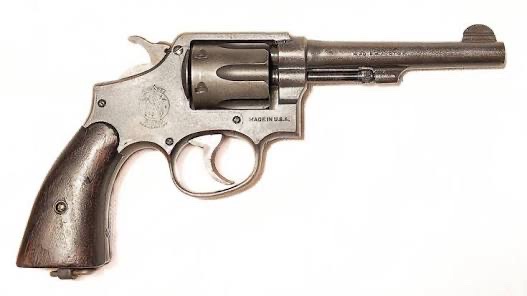
The Smith & Wesson Victory Model was one of the most important Allied sidearms of the Second World War. Based on the company’s proven Military & Police K-frame revolver, it was produced from 1942 after the United States entered the war, with the distinctive “V” serial number prefix giving the revolver its now-famous name. Britain ordered large numbers to supplement production of the Enfield No. 2 following the heavy equipment losses at Dunkirk, with most examples chambered for the British .38/200 (.38 S&W) cartridge. Rugged, reliable, and simple to maintain, the Victory Model quickly earned an excellent reputation among British and Commonwealth forces.
Designed for military service, the Victory Model featured a six-shot swing-out cylinder, a 5-inch barrel on most British contract revolvers, fixed sights, double-action operation, a lanyard ring, and a durable parkerised finish that was better suited to wartime production than the polished blue finish of pre-war commercial revolvers. Later production incorporated an improved hammer block safety, creating the desirable “SV” serial prefix variants. Although lacking the refinement of earlier commercial models, its reliability in harsh environments made it a trusted companion on battlefields across Europe, North Africa, and the Pacific.
Victory Models saw widespread service with the British Army, Royal Navy, Royal Air Force, Commonwealth forces, police units, and the Home Guard, while .38 Special versions were also issued to United States military personnel, particularly naval security, military police, and aircrew. After the war, many remained in military and police service throughout the Commonwealth before eventually being sold as surplus. Some British contract revolvers were later converted to fire .38 Special, although original .38/200 examples remain the most desirable among collectors today.
For collectors, the Victory Model represents far more than a wartime revolver—it symbolises the industrial partnership between the United States and Britain during one of history’s greatest conflicts. Examples retaining matching serial numbers, original parkerised finish, British military markings, and documented provenance are especially prized. Combining historical significance, dependable engineering, and widespread wartime service, the Smith & Wesson Victory Model remains one of the defining military revolvers of the Second World War and a worthy addition to any serious military firearms collection.


Leave a Reply