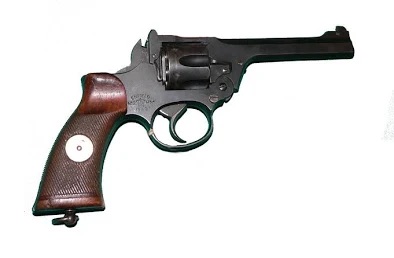
Up until recently I thought the Webley MKVI was the primary sidearm for the commonwealth forces in WW2. The Webley was definitely still around but the new primary revolver was the Enfield No2 mk1
The Enfield No. 2 Mk I is one of the most recognisable British service revolvers of the 20th century. Produced between 1930 and 1957, it fired the .38 S&W cartridge—often referred to in British service as “.380”—and became a standard sidearm across the British Empire during the Second World War.
After World War I, British military planners moved away from the powerful but heavy-recoiling .455 revolvers. The goal was a lighter, more manageable sidearm that could be quickly mastered by soldiers with minimal training. The answer came in the form of a .38 calibre revolver firing a heavy 200-grain bullet, designed to be effective at close range with less recoil and faster follow-up shots.
Although heavily influenced by Webley designs, the Enfield was developed at the Royal Small Arms Factory. It retained the classic top-break design, allowing for very fast reloading thanks to its automatic ejector, one of the defining features of British revolvers
There were three primary versions:
Mk I (1931) – Featured a spurred hammer and could be fired in both single and double action.
Mk I* – The most common wartime variant, with a spurless hammer and double-action-only operation for simplicity and faster training.
Mk I** – A simplified wartime production model introduced in 1942, though short-lived due to safety concerns.
Most Mk I revolvers were later converted to Mk I* standard during wartime servicing.
The Enfield No. 2 excelled in its intended role: close-quarters combat. Its relatively light trigger in double-action mode made it effective for rapid fire at short distances, though it wasn’t ideal for precision shooting beyond about 15 yards.
Soldiers had mixed opinions—while it was practical and easy to use, some preferred alternatives from Smith & Wesson, Colt, or Webley, particularly due to the heavier double-action trigger pull on the Mk I*.
Originally designed for the .38/200 cartridge with a 200-grain lead bullet, the revolver later used a 178-grain full metal jacket round during WWII to comply with international conventions. Both types saw combat use due to wartime supply demands.
Although officially declared obsolete after World War II, the Enfield No. 2 remained in service in some roles until 1969. Its widespread use across the British Empire—and even limited production in places like Australia—cemented its place as a classic military sidearm.
From a collector’s perspective, the Enfield No. 2 offers a fascinating blend of practical wartime design and subtle variation between models. Whether it’s a well-worn Mk I* or a rarer early Mk I, each example tells a story of adaptation and necessity in a changing era of military firearms.


Leave a Reply