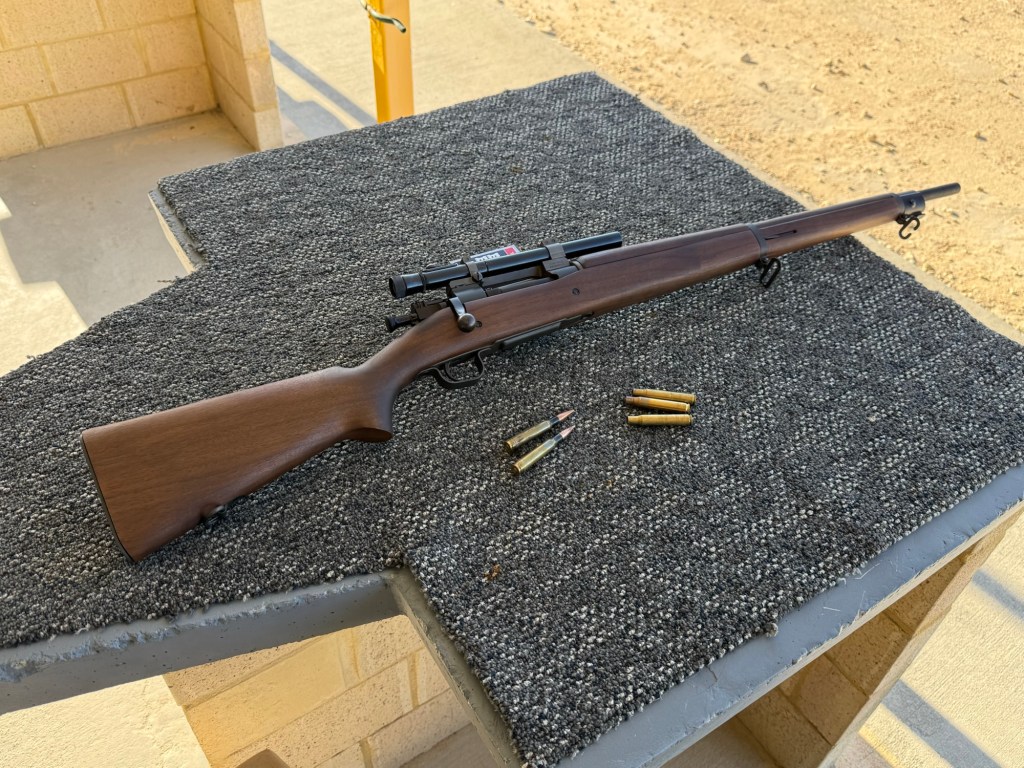
The rifle shown here is a replica of the famous American WW2 sniper rifle: The M1903A4. While it is not an original A4, it is built on a genuine M1903A3 action, which gives it real historical credibility. That said, the markings and serial numbers differ from those found on original A4 rifles.
World War II marked the first time sniper rifles were widely used in combat. Early on, the U.S. relied on M1903 National Match rifles that were quickly adapted for sniper duties. Later, the military began converting large numbers of M1903A3 rifles specifically for precision shooting, designating them as the M1903A4. These rifles were produced without iron sights, but the muzzle was still machined to accept a standard front sight base. One-piece Redfield scope bases were mounted using the rear sight location and secured to the front receiver ring.
Although labeled as M1903A3s, true M1903A4 sniper rifles had unique receiver markings. The markings on the front receiver ring were split so they could still be seen with the scope base installed. These rifles also used carefully selected receivers and barrels that met very tight specifications, ensuring consistent accuracy.
The M1903A4 was officially adopted on January 14, 1943, more than a year after the U.S. entered the war. The government initially directed 20,000 M1903A3 actions for sniper rifle production, followed by another order of 8,365 rifles five months later. Production ended less than a year after it began, with just under 30,000 rifles completed. Despite this relatively short production run, the M1903A4 saw service in World War II, the Korean War, and even into the Vietnam War.
In combat, the rifle performed well out to about 600 yards. Beyond that distance, its effectiveness was limited by the optics of the time. Standard-issue Weaver scopes had low magnification, usually 2.2X or 2.75X, and small 0.75-inch tubes that restricted the field of view. While an 8X Unertl scope was approved as an option, it was rarely issued, making long-range target identification difficult.
Years later, Gibbs Rifle Company began producing faithful M1903A4 replicas. These rifles used newly manufactured parts combined with original Remington M1903A3 actions. The actions came from deactivated drill rifles acquired when Gibbs purchased Parker-Hale’s rifle division in the 1990s. Each action was carefully restored and tested for proper hardness, and original, unissued World War II-era bolts were fitted.
New four-groove barrels were installed, receivers were correctly drilled and tapped, and replica mounts and rings were added. The rifles were finished with a Hi-Lux/Leatherwood reproduction of the M73B1 scope, which closely matches the original except for being waterproof.
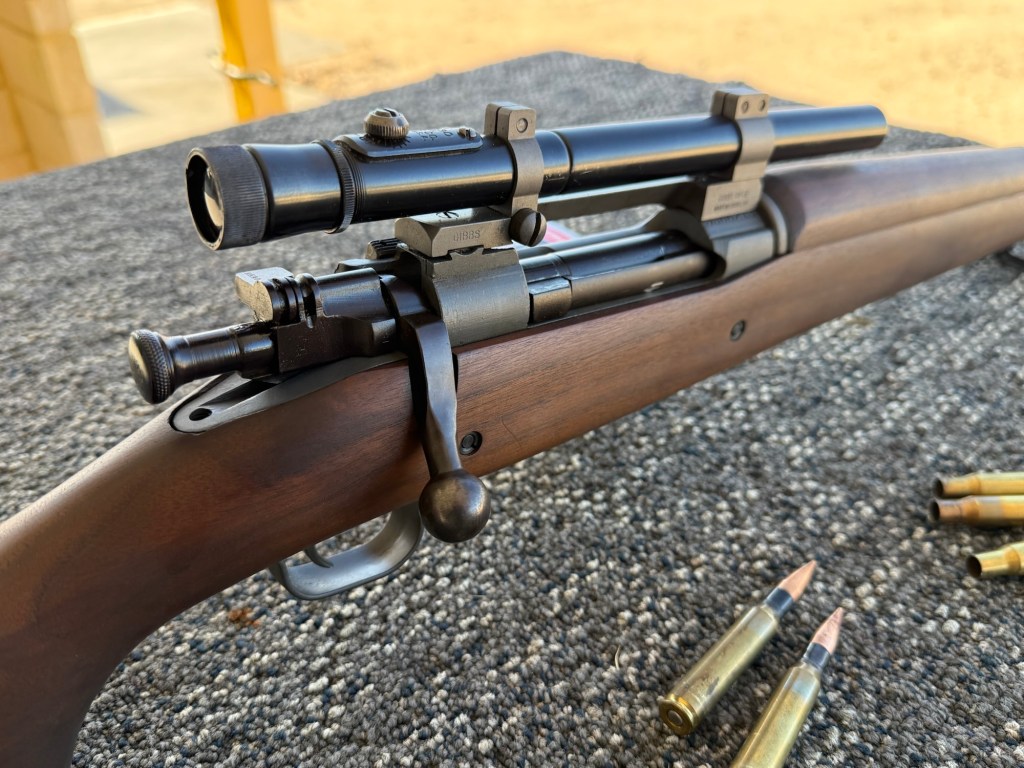
Me and my dad got my Gibbs M1903A4 rifle back in 2011.
The U.S. Model 1903 is a bolt-action rifle with dual locking lugs, a large Mauser-style claw extractor, and a three-position safety mounted on the bolt. It feeds from a five-round internal magazine that can be loaded one round at a time or by stripper clips. While stripper clips are still available today, they can’t be used on the 1903A4 because the scope mount blocks the guide. A small lever at the rear left of the action acts as both a bolt release and a magazine cutoff, allowing the rifle to be fired as a single shot while keeping a full magazine in reserve.
 Baker arms collection
Leave a comment