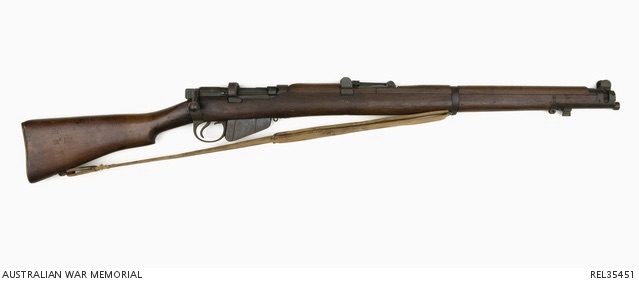
Its time to talk about the weapon of the ANZAC’s! Up until recently I thought that this rifle was only used in WW1. As I have always been well aware of the Lee Enfield No.4 which was the upgraded model. I thought that all commonwealth forces went into WW2 carrying No4’s but actually it turns out Australia only carried Lee Enfield No1 Mk3s. New Zealand apparently started with No1’s but slowly upgraded to the new No’4s as the war went on.
Now let’s dive into what makes this iconic rifle so legendary!
This rifle is by far the most well-known Lee–Enfield was rifle, it was introduced on 26 January 1907 with the Pattern 1907 bayonet. It featured simplified sights, a fixed charger guide, improved handguards and magazine design, and was adapted to fire the new Mk VII high-velocity .303 ammunition. Many earlier Lee–Enfield and Lee–Metford rifles were rebuilt to this standard, known as “Mk IV Cond.”
The No. 1 Mk III also included a cleaning kit stored in the buttstock, with a pull-through, cloths, and an oil bottle.
During World War I, the Mk III was considered too complex and costly to produce, so the simplified Mk III* was introduced in 1915. It removed features like the magazine cut-off, volley sights, and windage adjustment. Some changes were added gradually across factories. The magazine cut-off returned after the war and wasn’t fully phased out until 1933, with some rifles still using it into the 1960s.
The rifle was later adapted for grenade launching, using a removable cup and blank rounds to fire modified Mills Bomb grenades up to about 200 yards.
Because major factories couldn’t meet wartime demand, Britain used the “peddled scheme,” outsourcing production and quadrupling output in the first year of the war.
The Mk III* served widely in World War II across North Africa, Italy, the Pacific, and Burma. Australia and India continued producing it as a standard rifle, with Australia keeping it through the Korean War until replaced by the L1A1 SLR in the late 1950s. Lithgow stopped production in 1953.
India’s Ishapore factory later developed the 2A and 2A1 models, strengthened to fire 7.62×51mm NATO, and production continued into the 1980s.
The rifle became widely known simply as the “three-oh-three.”
 Baker arms collection
Leave a comment