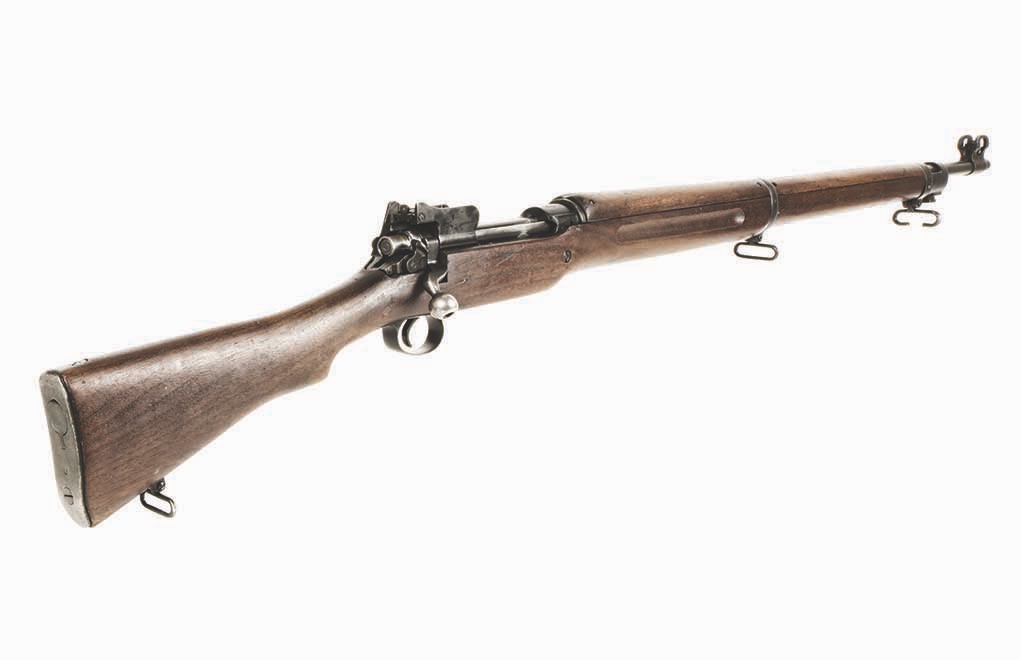
I enjoyed writing about the pattern 1914 Enfield so much I must talk about US adaptation of that very rifle.
From a collector’s point of view, the M1917 Enfield is one of those rifles that quietly did the hard work of history, yet never quite got the credit it deserved.
Officially known as the United States Rifle, Calibre .30, Model of 1917, the M1917 is essentially an American adaptation of the British Pattern 1914 Enfield. Despite the name, it has nothing to do with the Lee–Enfield. Instead, it is a big, strong Mauser-inspired bolt-action rifle that became the most widely issued American rifle of the First World War.
Before the Great War, Britain was already questioning the limits of the SMLE and its .303 cartridge, especially after facing accurate long-range fire from Mauser rifles during the Boer War. This led to the development of a new rifle at Enfield, heavily influenced by Mauser design principles. The original plan was to chamber it for a powerful new .276 Enfield cartridge, but the round proved impractical under wartime conditions.
When war broke out, Britain urgently needed rifles and turned to American manufacturers. The design was reworked to fire the familiar .303 British cartridge and became the Pattern 14. Winchester, Remington, and Remington’s Eddystone plant all produced the rifle.
When the United States entered the war in 1917, it faced the same problem: not enough rifles! Rather than retool factories to make more M1903 Springfields, the U.S. wisely adapted the existing Enfield design to the .30-06 Springfield cartridge. The result was the M1917 Enfield.
Production was enormous. Between Winchester, Remington, and Eddystone, over two million M1917s were built, easily outnumbering the M1903. By the end of the war, around three-quarters of American troops in France were carrying the M1917.
The rifle earned a solid reputation for strength, reliability, and accuracy. One of the most famous users was Sergeant Alvin C. York, who carried an M1917 during the action that earned him the Medal of Honor.
Despite this, the M1917 never quite shook its “stand-in” status, even though it was arguably better suited to mass wartime production than the Springfield.
After the armistice, most M1917s went into storage, though many were later sold as surplus. A large number were sporterised, and the action proved so strong and popular that Remington built new sporting rifles from it as the Remington Model 30.
Various countries adopted or experimented with the rifle, including Honduras, which fielded a 7×57mm version, and others who rechambered surplus rifles to different calibres.
At the start of the Second World War, the M1917 returned to service in secondary roles. It armed artillery crews, chemical mortarmen, training units, and Home Guard forces in Britain. Canada also purchased tens of thousands to cover shortages.
The rifle saw service in surprising places long after its supposed retirement. It appeared with Chinese forces in Korea, in various post-war conflicts, and even today remains in active service with the Danish Sirius Dog Sled Patrol in Greenland, chosen for its reliability in extreme Arctic conditions.
From a collector’s perspective, the M1917 has real presence. It is long, heavy, and unapologetically robust. The action was originally designed for a very powerful cartridge, which explains its strength and smooth bolt operation.
A Mauser-style action with a distinctive dog-leg bolt handle Cock-on-closing operation, inherited from British practice An excellent rear aperture sight protected by sturdy “ears” A six-round magazine capacity in .30-06 A long, heavy barrel that contributes to excellent long-range accuracy
It is heavier than the M1903 Springfield, and its length made it awkward in trenches, but on the range it shines. The sight picture is superb, and the rifle has a solid, confidence-inspiring feel that collectors quickly appreciate.
Often overlooked in favour of the 1903 Springfield or the M1 Garand, the M1917 deserves far more respect. In many ways, it was the rifle that actually won America’s first modern war.
 Baker arms collection
Leave a comment